

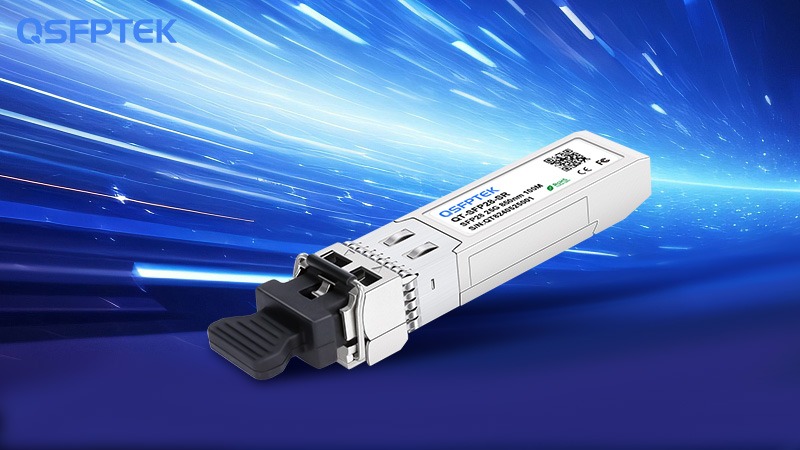
Enterprise data centers are facing steadily increasing bandwidth demands driven by virtualization, private cloud deployments, and data-intensive business applications. Unlike hyperscale cloud providers, enterprises typically operate within fixed budgets and longer infrastructure refresh cycles. As a result, network upgrades must be carefully planned to deliver measurable performance improvements without introducing unnecessary cost or operational complexity.
For many organizations, 10G networks are reaching their practical limits, but jumping directly to 100G at the access layer is neither economical nor required. This gap is where 25G SR optical modules provide a highly effective upgrade path.
Why 25G SR Fits Enterprise Requirements
25G SR offers a clear advantage for enterprise environments by delivering 2.5 times the bandwidth of 10G while maintaining a similar deployment model. It provides sufficient capacity for modern server workloads without the higher costs and design complexity associated with 40G, 50G, or 100G solutions.
Because enterprise data centers typically prioritize stability and predictable performance, 25G SR aligns well with their operational goals. It enables meaningful bandwidth growth while allowing IT teams to stay within familiar architectures and processes.
Leveraging Existing Multimode Fiber Infrastructure
One of the strongest arguments for the SFP28 SR module in enterprise data centers is its compatibility with existing multimode fiber cabling. Many facilities already use OM3 or OM4 fiber for short-reach links within racks or across data hall rows. 25G SR supports distances of up to 70 meters on OM3 and 100 meters on OM4, making it possible to upgrade link speeds without replacing fiber.
By reusing installed cabling, enterprises can significantly reduce both capital expenditure and deployment time. This approach also minimizes downtime, which is critical for business-critical environments where maintenance windows are limited.
Practical Network Architecture Benefits
From an architectural standpoint, 25G SR works well in common enterprise designs such as top-of-rack and end-of-row switching. Deploying 25G server-to-switch links allows enterprises to support higher virtual machine density, faster east-west traffic, and improved storage performance.
In addition, 25G integrates smoothly with higher-speed aggregation layers. Enterprises can deploy 25G at the access layer and connect to 100G switches using breakout configurations, enabling gradual and controlled scaling as demand grows.
Cost and Operational Efficiency
Cost efficiency is a defining factor in enterprise networking decisions. Compared to higher-speed optics, 25G SR modules are more affordable, consume less power, and generate less heat. This helps reduce both upfront hardware costs and long-term operational expenses related to cooling and energy consumption.
Operationally, 25G SR modules are mature and widely supported across networking platforms. They use proven VCSEL technology and standard LC connectors, making installation, monitoring, and troubleshooting straightforward for enterprise IT teams.
Conclusion
25G SR is not designed to replace high-speed optics in core networks, nor is it intended for hyperscale architectures. Instead, it offers a balanced, cost-effective solution tailored to enterprise data centers that need more bandwidth without unnecessary complexity. For organizations planning a gradual transition away from 10G while maintaining budget control and operational simplicity, 25G SR represents a practical and future-ready choice that delivers real performance gains today while supporting scalable growth tomorrow.
