

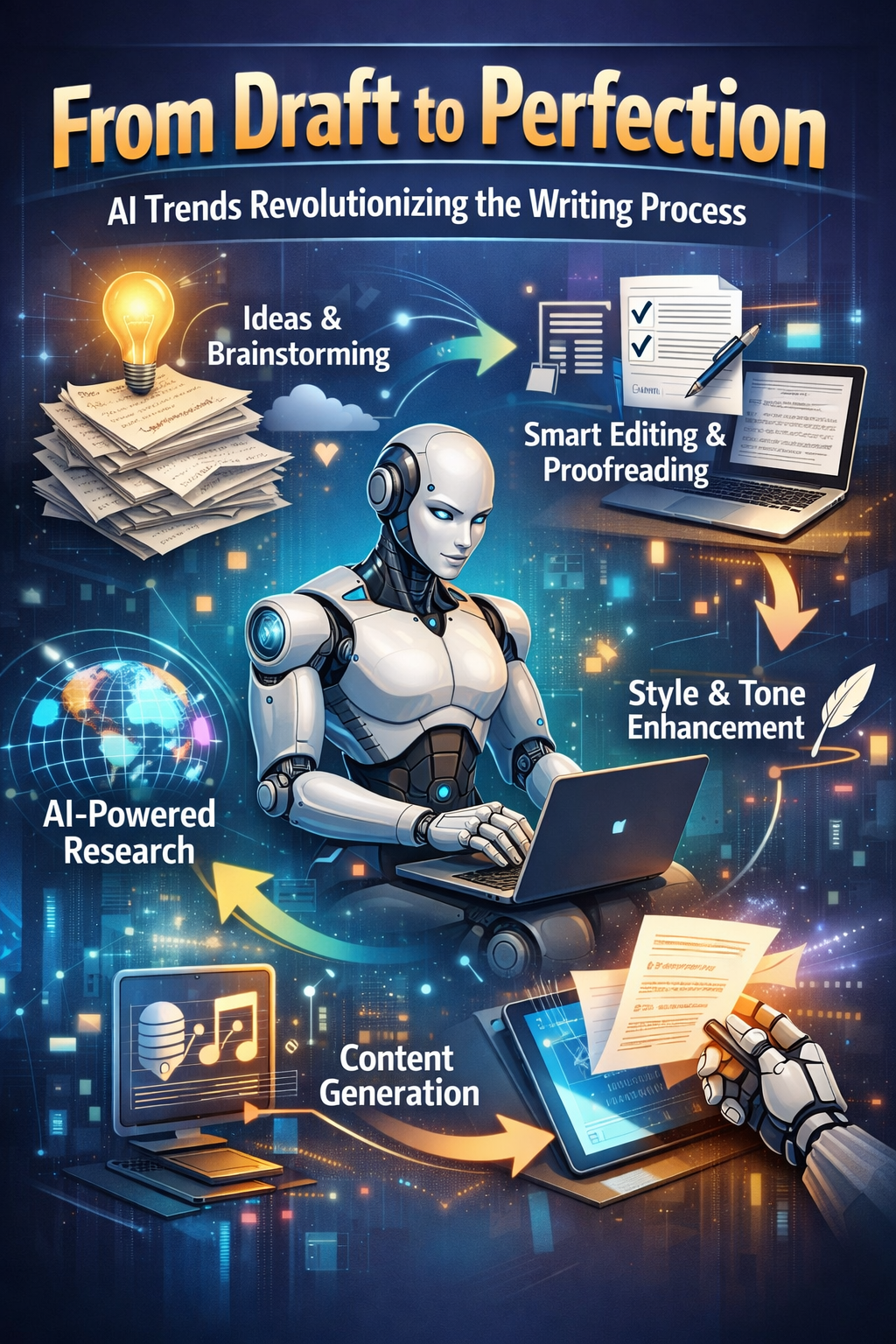
There’s a thin line left between human creativity and machine intelligence. Earlier, it used to be science fiction that computers would help us think, write, and even create art, which has now become a part of our daily lives. In the world where we are living, AI has become more than just a writing assistant, but it collaborates with them during the whole process. From brainstorming new ideas until the final drafts are ready, AI is no longer a mere assistant but rather a reliable creative companion. Now it has become a co-author who never disappoints, forgets, or gets tired of ideas.
In this article, we will discuss the way AI will transform the writing process – starting with the initial seed of an idea and ending with the finished work. We will explore the fundamental trends pushing this change, how AI is altering the nature of collaboration, and how AI is making the experience of writing individual and business more personal.
We’ll also discuss the growing role of automation in editing and publishing, the ethical questions that come with AI-generated text, and what the future of AI-enhanced writing might look like.
Key Takeaways:
- AI can transform editing from correction to intelligent creative collaboration.
- Modern AI-based tools can refine tone, rhythm, and emotional balance effectively.
- AI preserves the writer’s authentic voice through adaptive learning.
- Human insight and machine precision now work hand in hand.
- AI empowers editors to achieve perfection faster and more efficiently.
How AI Transforms the Creative Genesis
Any good piece of writing starts with an idea, yet the trickiest part of the process is creating one that will be appealing. AI has achieved this by combining human imagination and computational intelligence. It is not only about generating random prompts but also about understanding how ideas are formed and offering writers a smarter, more structured creative roadmap. This shift benefits all types of writing—from academic projects to professional services like a law essay writing service, where clarity, direction, and precision are essential.
All AI-based writing tools rely on natural language processing (NLP), which analyzes millions of texts, patterns, and writing styles. When a user enters a topic, the system produces relevant directions, outline structures, thesis statements, or even story frames. This helps authors overcome indecisiveness in seconds, allowing them to focus on productivity instead of hesitation.
Most advanced AI tools integrate powerful data analytics to decode reader expectations and cultural contexts. They scan trending discussions, scholarly databases, and modern AI insights to help writers choose meaningful, timely topics. This bridges the gap between what writers want to express and what audiences need to hear—turning creativity into intentional communication. Instead of flipping through dozens of sources manually, AI retrieves and summarizes essential information effortlessly. Beyond summarization, it can generate citations, context maps, and structured research insights.
Numerous systems like Elicit, Semantic Scholar, and Perplexity AI gather evidence-based references and even evaluate source credibility. This gives students and professionals a more informed, critical starting point in the writing process—where creativity is strengthened by knowledge. Whether crafting research, storytelling, or brainstorming design concepts, AI brings structure, depth, and innovation to every stage of creation.
The Evolution of the AI-Assisted Draft
The drafting process has become less of a slow and lonely process and more of a dynamic process between humans and intelligent systems. Big Language Models (LLMs) such as GPT-5 and Claude have become virtual co-authors, assisting writers to transform their unstructured thoughts into refined copy in seconds and with accuracy.
● Machine Co-Authors in the Writing Room:
AI can be used to produce coherent and tonally consistent text, which means that a writer can experiment with a variety of structures or narrative directions and select the most suitable one. Such freedom gives rise to experimentation and increases creative limits.
● Maintaining the Human Voice:
While AI accelerates writing, the heart of the message still comes from humans. Emotion, rhythm, and personal insight keep writing authentic. AI works best as an enhancer — refining style without erasing individuality.
● Adaptive Drafting Environments:
Platforms such as Notion AI, Google Duet, and Microsoft Copilot learn from user habits and tone, offering contextual support in real time. The result is a symbiotic process where human intuition and machine intelligence craft prose in perfect motion.
How AI Helps Writers Reach Every Reader
Writing is not just about putting sentences together, but it has to be something that connects with the readers directly. With the incorporation of AI-based tools, this job is done in a better and more convenient way. Be it a school essay, a blog post, or a story, with the involvement of AI, your work will be fine-tuned, structured, and clearer so that every message feels natural and meaningful.
● Writing for the Right Audience:
When you give AI the right prompt, it writes for you in a more meaningful way, adjusting the tone accordingly. Your work will be more formal and precise. Following the targeting audience, it will write content that is more everyday-friendly and easier to read. This lets writers focus on ideas, while AI makes sure those ideas connect with readers in the right way.
● Making Every Line Clear and Easy to Find:
AI aids writers in making their words smoother and more visible on the internet. It checks flow, word choice, and keywords so that writing is not only clear but also easier for others to discover.
● Sharing Ideas Across the World:
AI also contributes to breaking language barriers, letting stories and knowledge reach audiences around the globe. AI enables you to convey your thoughts to someone halfway across the world, instantly and effortlessly.
To put it in simple words, AI gives writers the strength to connect hearts and minds. It helps every word find its place, and every reader finds meaning in it.
The New Age of AI Editing
The editing process has always been the stage where raw ideas are refined into polished, effective writing. With the emergence of AI, this process has become smarter, faster, and more accurate than ever before. Modern AI-powered editing tools go beyond detecting grammatical errors—they understand tone, style, clarity, and even sentiment. These intelligent systems redefine what it means to polish a draft and help writers elevate their work with each revision. For those exploring deeper insights into personal and professional growth through writing, topics like “What are the 5 benefits of writing” offer an excellent complement to how AI enhances the overall writing process.
● Intelligent Editing Beyond Editing:
The AI systems no longer just notice the mistakes in language. They detect clumsy wording, rhythm, and logical errors. Such tools as Grammarly, ProWritingAid, and QuillBot provide an analysis of the sentence flow and context and provide suggestions to enhance it and make the text clear and coherent without losing meaning.
● Style Consistency & Style Preservation:
Having a good voice is an essential part of creative and professional writing. Now, AI can adjust the tonality of a specific writer, so no paragraph will sound like the other. This voice learning skill enables material to remain faithful to its creator, despite being highly edited.
● From Proofreading to Polishing:
The new AI editors are more like electronic companions than red pens. They do not merely eliminate mistakes, but improve the rhythm, change the sentence structure, and create emotional balance. This transformation transforms editing to a mechanical cleaning process into a creative interaction between the writer and the machine.
The AI does not take the place of the editor, but it makes him stronger in this new age of revision. Having the ability to blend the human eye and machine accuracy allows writers to have a degree of polish that was previously achieved by writing numerous drafts.
How AI Perfects and Publishes the Final Work
Once the words are written and refined, the final step is bringing them to life — and AI is changing that part too. Today, writers don’t just use AI to create content; they use it to perfect and present it. From the last round of proofreading to smart publishing tools, AI helps make sure every piece looks professional, polished, and ready to reach the world.
● Smart Proofreading and Polishing:
AI now goes far beyond catching spelling mistakes. It checks tone, sentence balance, and readability. It can even suggest smoother transitions and flag confusing phrases. This helps writers turn good drafts into pieces that feel complete, confident, and easy to read.
● Clean Formatting Made Simple:
Tools powered by AI can organize text automatically — adding headings, bullet points, citations, or layouts that make reading pleasant. Writers no longer have to worry about tiny formatting details; the system takes care of them.
● Smarter Publishing and Sharing:
AI also assists with choosing the right title, hashtags, or posting time for blogs and articles. Some platforms even predict what kind of content will perform best online. This means writers can reach wider audiences with less effort and more insight.
In A Nutshell
Over the past few years, we have all seen an excessive use of AI writing tools that have changed the way people express their thoughts. Platforms like ChatGPT, Claude, Jasper, Sudowrite, and GrammarlyGO have become the most approachable tools for writers, marketers, students, and even novelists. Earlier, students and people in writing professions used to use it for editing purposes, but now it has gone beyond that. Now they help with idea generation, tone refinement, storytelling, and even emotional expression.
Hence, the usage of generative AI technology has changed the way we used to create text, images, and even music. Now writers don’t have to stare at black pages, but they can simply collaborate with AI systems that provide structure, research support, and even creative direction. The result? Faster workflows, more polished content, and limitless inspiration. AI has made writing not just easier, but also more interactive and dynamic than ever before.
