

Dejan Kvrgic is the Senior Marketing Manager at AppMakers USA and serves as CMO, responsible for growth strategy and acquisition planning. With 10 plus years in digital marketing, he focuses on positioning, channel execution, and performance measurement that ties back to real customer demand. Outside of work, he spends time on sports, outdoor activities, gaming, and flying drones.
Most businesses do not wake up one day and decide to run on a messy app.
It happens slowly.
A bug gets patched. Then another one. A feature gets added in a hurry. Then a shortcut gets taken because the team is busy and the fix feels “good enough for now.” A year later, the app still works, but not well. It is slower, harder to maintain, and far more expensive than anyone wants to admit.
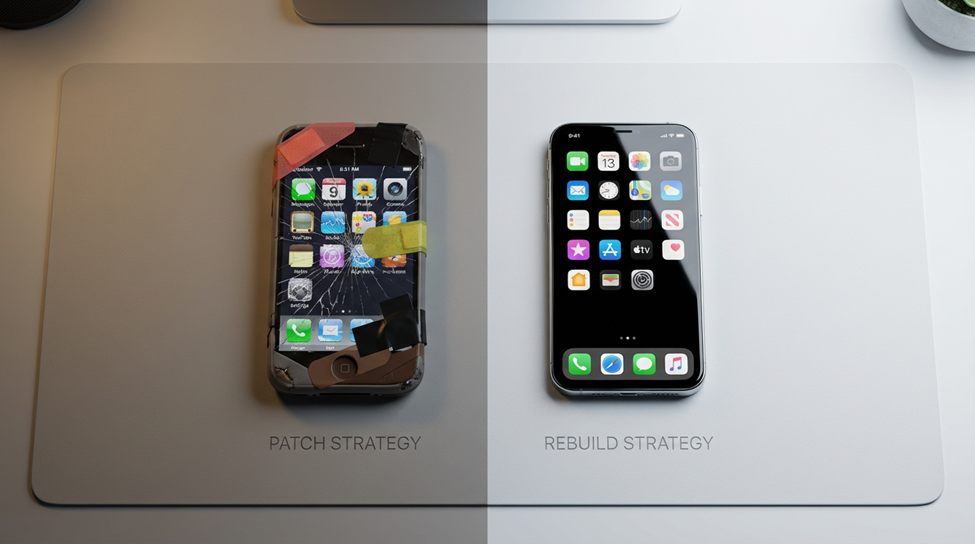
That is usually the point where leaders start asking the real question: should we keep patching this thing, or is it finally time to rebuild?
There is no universal answer. Some apps just need cleanup. Others are burning money quietly every month and should have been rebuilt much earlier.
The hard part is knowing the difference.
When Patching Still Makes Sense
Patching is not always the wrong move.
If your app has a stable foundation, a loyal user base, and only a few isolated issues, fixing what is broken can be the smartest financial decision. Not every old app needs to be thrown out. Sometimes the product is still structurally solid, and the problem is just that small issues have been stacking up.
A patch-first approach usually makes sense when:
The app still performs well for users
If the app is fast enough, reliable enough, and users are not dropping off because of technical friction, a rebuild may be overkill.
Your team understands the codebase
A messy app becomes much riskier when only one person knows how it works. If your team can still update the system confidently, you still have options.
The business model has not changed much
If the app is doing the same core job it was originally built to do, the existing structure may still support the business.
The problems are narrow, not systemic
A payment bug, a reporting issue, or a broken integration can often be fixed without tearing apart the entire product.
In other words, patching makes sense when the app still has a future in its current form.
When Patching Becomes a Bad Business Decision
This is where a lot of companies stay stuck for too long.
They keep approving one more fix because each individual fix feels cheaper than a rebuild. On paper, that logic sounds responsible. In practice, it often becomes the more expensive path.
An old app starts costing more than people realize when it creates drag across the business.
Development slows down every quarter
If simple updates now take much longer than they should, that is not just a technical issue. That is an operational problem. Slow releases mean slower learning, delayed improvements, and more missed opportunities.
Bugs keep coming back
Recurring issues are usually a sign that the core structure is unstable. You are not solving the problem. You are buying temporary relief.
Integrations have become painful
Modern businesses rely on connected tools. Payment systems, CRMs, analytics platforms, support software, marketing systems, and internal dashboards all need to work together. If every new integration feels like a risk, your app is probably fighting the business instead of supporting it.
The user experience feels outdated
Customers may not use the phrase “technical debt,” but they definitely feel it. Slow loading, awkward flows, broken screens, or inconsistent experiences damage trust fast.
Your maintenance budget keeps rising
At some point, the cost of keeping an old system alive starts to rival the cost of rebuilding it properly. That is usually the moment leaders need to stop looking at short-term invoice totals and start looking at total business impact.
The Real Cost of Waiting Too Long
The biggest mistake is assuming delay is neutral.
It is not.
When a weak app stays in place too long, the cost shows up in places that do not always get tracked clearly. Teams waste time working around product limitations. Support deals with avoidable complaints. Marketing struggles to push a product that does not convert well. Leadership keeps making decisions based on a system that no longer reflects where the company is trying to go.
That kind of drag adds up.
The rebuild conversation often starts too late because nobody wants to be the one to suggest a larger investment. But waiting until the app becomes a full-blown liability usually makes the rebuild more urgent, more complex, and more disruptive.
A rebuild done too late is often rushed.
A rebuild done at the right time is strategic.
That difference matters.
Questions That Help You Decide
If you are trying to figure out whether to patch or rebuild, these are the questions worth asking:
Is the app limiting growth?
If the product cannot support new features, new revenue opportunities, or changing customer expectations without major pain, you are dealing with more than normal maintenance.
Is the team solving the same problems repeatedly?
Repetition is a warning sign. If the same categories of issues keep showing up, the structure underneath them is likely the real problem.
Would a rebuild simplify operations over the next few years?
This is where many companies think too narrowly. A rebuild is not only about cleaner code. It can improve release speed, reduce support pressure, strengthen security, and make future improvements cheaper to ship.
Do you have a clear product direction now?
A rebuild makes more sense when the business has matured. If you now know your users better, understand your revenue model better, and have a stronger view of what the product should become, rebuilding on better assumptions can be the right move.
Is your current team equipped for the next stage?
Sometimes the app is not the only thing that needs rethinking. Businesses often reach a point where they need a more experienced mobile app development company to assess whether the old product is worth saving or whether the smarter move is to rebuild with a clearer roadmap.
That decision should not be emotional. It should be based on business value, technical reality, and long-term cost.
Rebuilding Does Not Mean Starting Blind
One reason companies avoid rebuilding is fear.
They assume it means throwing everything away and starting from zero. That is not always true.
A smart rebuild keeps what still works. It keeps the lessons, the user feedback, the useful data, and the strongest parts of the product strategy. What changes is the foundation.
That is an important distinction.
A rebuild is not an admission of failure. In many cases, it is proof that the business has learned enough to build the next version properly.
That is a much healthier way to look at it.
Final Thoughts
Old apps do not usually fail all at once.
They wear businesses down gradually.
That is why this decision is easy to postpone. The pain arrives in small pieces, and every short-term fix gives the illusion that things are still under control.
But if the app is slowing down your team, frustrating users, raising maintenance costs, and making growth harder, patching is no longer the conservative option. It is just the familiar one.
At that point, the better question is not whether a rebuild feels expensive.
It is whether continuing to patch a weak foundation is costing even more.
